Categories
Life

Writing as a Tool for Thought

We tend to think of writing primarily as a tool for communication. And, to be honest, it is primarily a tool for communication. Maybe communication to someone else, maybe communication to a version of you or someone else in the future (i.e. record-keeping), but we write things down – mainly – in lieu of saying them face-to-face. But I think we sometimes overlook writing’s usefulness as a tool for refined thinking and problem-solving.

The easiest in-road for this idea is journaling. Journaling is having a moment right now, and for good reason: it helps. I don’t have a study to link here (you can search for it if you’re curious), but I can say, anecdotally, that journaling is very helpful for me, personally. Have you ever had the experience of explaining a problem to someone and just hearing yourself say it out loud, you come up with the solution? Journaling is kind of like that sometimes, with the added benefit that you can go back and look over what you’ve written.

But writing isn’t just a tool for thought in the sphere of mental health. When I’m starting a big, complex project for my company or for my day job, I often start with a document. I write out the objectives, I write out the unknowns, I list the options, and anything else that seems relevant to the project. Often, I’m the only one that reads them, but that’s enough. Because writing is a thinking tool.

There’s something magical that happens when you write down (and, critically, revise) an idea. It’s like having a conversation with yourself. Ideas that sounded perfect in your head, when they transition into the reality of the written word, reveal some of their flaws. Maybe it has something to do with the fact that writing – at least, good writing – requires you to take the perspective of the reader, so in a way, you have to imagine and account for the feedback given by other people. Or maybe it’s just the fact that seeing the ideas all in one place allows you to organize your thoughts better.

When I write a plan, in an exercise that often appears needlessly bureaucratic and red-tape-y, I don’t spend most of the time editing: I spend most of the time revising. I write, rewrite, delete, and move around sentences and sections until the document in front of me contains the most complete and succinct version of the idea I can create. As I’m writing, new ideas usually occur to me that were either missing from the original plan or that would make it better. Then, I put the document down for a while. I walk away, do something else, and give the paper (often digital paper, these days) and the ideas on it some time to age. I give myself some time to age too. When I come back with fresh eyes, there are some inevitably some changes I want to make. You miss out on all that evolution if you just rush into a project without writing.

I suggest you try it. The next time you’re trying to do something that you can’t quite wrap your mind around, write it down. Write down all the options you’ve considered, and why you picked the one you’ve picked. Organize it into sections. Then edit. Try to make it as clear as possible. And see what happens.
Categories
Publishing

Smallest Viable Audience

Why Shrimp Cult Press Doesn’t Use On-Demand Publishing

At Vancouver Fan Expo this past February, a woman and her daughter came up to our booth and started talking with us. Like a lot of people, they had questions about the company, what we do, how we work, etc. This particular person, however, got started talking about on-demand book publishing. She was very passionate about it, and seemed to think it was the only sensible way for a publisher to make money and gain visibility.

In the moment, this advice felt wrong to me, especially since Shrimp Cult Press publishes to a particular niche: people who like off the wall, silly humour and graphic novels or TTRPGs. Those people aren’t buying their D&D books at Indigo or Barnes and Noble. I know this because I’m one of them, and so are many of my friends. We buy from the local game shop, or Kickstarter, or even a small independent publisher, if we can. But I’ve spent some time thinking about why this advice felt just so wrong for my company and mission and in the days that followed, it was hard to articulate to myself exactly why. In a blog post published today, Seth Godin lays out exactly why the print-on-demand model isn’t what Shrimp Cult Press is after. As usual, Seth Godin cuts straight to the point.

I recommend you read his blog post here. It will only take a minute.

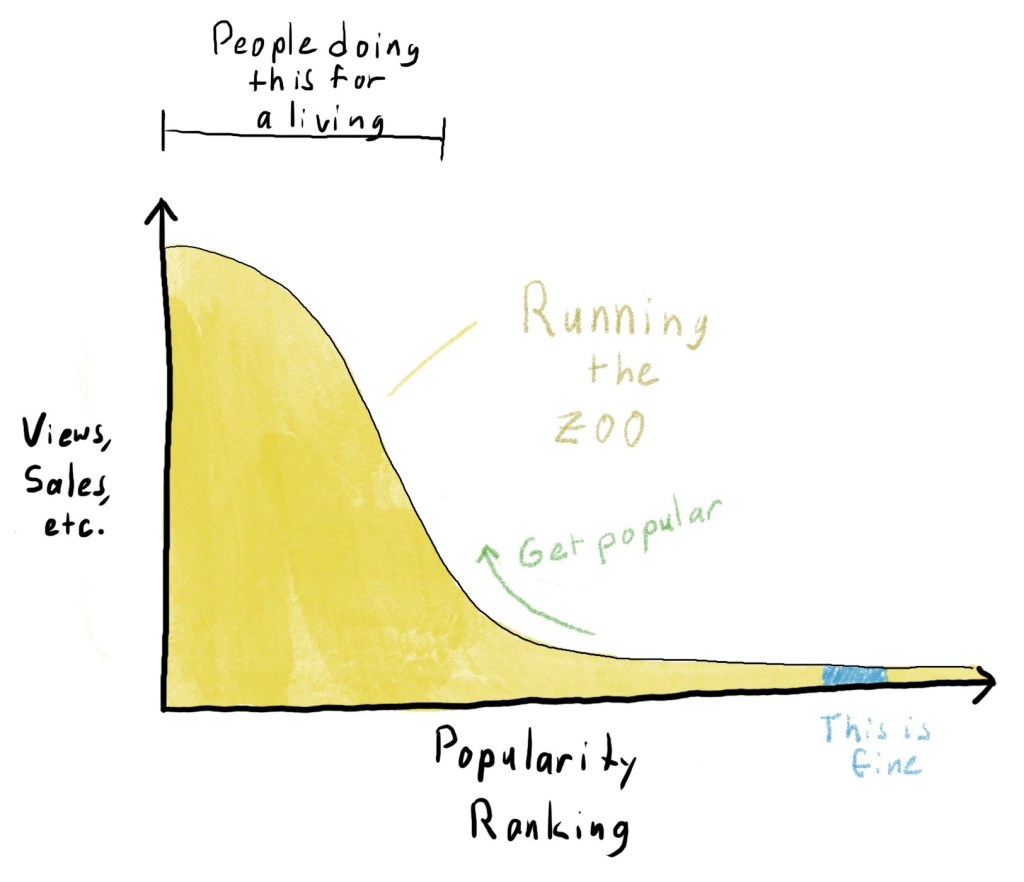
In the long-tail business model he describes, there are three categories of successful parties: people who migrate leftward from the long tail to the height of popularity, people who are fine staying in the long tail and not making much money, and the company operating the business as a whole.

Migrating leftward is hard. It takes time, dedication, broad appeal, and a lot of luck. You’re taking on the task of becoming Mr. Beast or Markiplier*. Being a money maker in a long-tail business means being popular or betting that something you make will become a viral sensation. In a sensational world, it’s getting harder and harder to be a sensation. And is that even what you want to do? Going viral doesn’t just mean making something that people love, it means making something that people are rabid about for a short period of time. Harnessing that success means keeping the hits coming.

Then there are people who are happy to get a few hundred views on YouTube or sell fifty-ish books to friends and friends-of-friends. That’s a fine and noble goal. But these people aren’t trying to run a business.

A graph comparing number of views or sales by ranking in popularity. Sales are high for the most popular few, but drop off quickly.
Ranking Versus Views

Shrimp Cult Press isn’t running a long-tail business model like Amazon. I do want it to be a successful business, but I also have no interest in turning my company into a hits machine with influencer-like appeal.

Printing on-demand would mean struggling to migrate leftward, pushing and fighting through the crowd to reach the front of the line. Yes, there’s an immediate cost savings to printing on-demand, but the low margins mean that you have to go even farther to escape the long-tail. If you’re only making a few bucks per book, the number you have to sell to be profitable is in the thousands. per month. Our most recent book, Pizza Pigeon: The Search for the Lost Parm, has almost paid for its printing in the first month since it’s been out. And everything from here is clear profit. You don’t get that from on-demand printing.

With the low margins of on-demand printing, you also can’t afford distribution outside of whatever printer you’re working with. Distributors take 30 to 40 percent off the cover price of your book. If you print on-demand, you’re locked into the printer’s audience. No small bookstores for you.

Printing the old fashion way has its downsides, but it’s easier to make more money once your audience reaches a certain (much smaller) size. It’s easier to be proud of the things you’re making, too.

It’s also worth noting that there are multiple ways to do just about anything. And it’s a wise to be suspicious of anyone who tells you that their way is the only way to be successful.

* I feel like I’ve just aged myself by referring to YouTubers, and that’s wild to me.