Categories
Life

Moving a Concrete Block

When you’re burnt out, small obstacles can turn into enormous walls in your mind. When you feel behind, overwhelmed, and out of energy all at once, a task that’s big and important can feel enormous and critical. Something that helps me – and which I often forget to do – is to find a small thing I have the energy for right now that will make progress easier later.

Imagine you’re trying to move a concrete block from one side of a yard to another. It’s small enough that you can lift it, but large enough that moving it takes some effort. And you’re just. so. tired. You need to move the block, but you don’t have it in you right now. You have a few options.

First, you could push yourself and just lift it anyway. Never mind the damage you might do to your body or the lack of respect you’re showing your own needs in this moment. Time waits for no one, and the time is now. Sometimes, we have to do this. Other times, we convince ourselves that we have to for some reason. I think the unhealthy version of this often boils down to trying to prove something to someone in your past who told you that you weren’t good enough. At least, that’s what it usually ends up being for me.

The next option is to put it off completely. The block is just staying there. It’s inevitable. There might be a choice for someone else, but for me? No way. I give up. Again, sometimes this is the right choice. Picking your battles is important and healthy. Maybe the block, on reflection, doesn’t need to get moved as much as you thought it did. Or maybe moving it isn’t as important as other things. Other times though, we bury our heads in the sand because solving the problem seems too overwhelming. Most problems though, big and scary though they might be, have a weakness. Some problems get solved with a single, big, focused effort, and others can’t survive being chipped away at slowly and consistently. One indicator of whether giving up is a good choice is whether you’re walking away or running away. And, if you’re running, why are you running*?

Here’s the other option that I alluded to in the beginning: ask yourself, “What can I do now that will make the problem easier to solve later?” Maybe you can attach handles to the block so that, when you have energy, moving it be just 10% easier. Maybe you can call a friend and ask them to come help move the block next Tuesday. Or maybe it’s easier to cut the block up and move it in pieces.

Critically, you aren’t using this newfound approach as a way to force yourself to move the block now. You’re finding a small thing you can do now that will make it easier later once you’ve recovered.

*A quick note about running away: Some people will tell you that you should never run away from a situation, unless you are running toward something else. This absolute statement isn’t always true. People who truly believe this would be eaten by a tiger or crushed by a falling building as they calmly looked around for somewhere better to be. While it’s true that it’s often better to be proactive than reactive, if the situation you find yourself in is unhealthy or dangerous – be it physically or emotionally – running might absolutely be the right way to go.
Categories
Life

Writing as a Tool for Thought

We tend to think of writing primarily as a tool for communication. And, to be honest, it is primarily a tool for communication. Maybe communication to someone else, maybe communication to a version of you or someone else in the future (i.e. record-keeping), but we write things down – mainly – in lieu of saying them face-to-face. But I think we sometimes overlook writing’s usefulness as a tool for refined thinking and problem-solving.

The easiest in-road for this idea is journaling. Journaling is having a moment right now, and for good reason: it helps. I don’t have a study to link here (you can search for it if you’re curious), but I can say, anecdotally, that journaling is very helpful for me, personally. Have you ever had the experience of explaining a problem to someone and just hearing yourself say it out loud, you come up with the solution? Journaling is kind of like that sometimes, with the added benefit that you can go back and look over what you’ve written.

But writing isn’t just a tool for thought in the sphere of mental health. When I’m starting a big, complex project for my company or for my day job, I often start with a document. I write out the objectives, I write out the unknowns, I list the options, and anything else that seems relevant to the project. Often, I’m the only one that reads them, but that’s enough. Because writing is a thinking tool.

There’s something magical that happens when you write down (and, critically, revise) an idea. It’s like having a conversation with yourself. Ideas that sounded perfect in your head, when they transition into the reality of the written word, reveal some of their flaws. Maybe it has something to do with the fact that writing – at least, good writing – requires you to take the perspective of the reader, so in a way, you have to imagine and account for the feedback given by other people. Or maybe it’s just the fact that seeing the ideas all in one place allows you to organize your thoughts better.

When I write a plan, in an exercise that often appears needlessly bureaucratic and red-tape-y, I don’t spend most of the time editing: I spend most of the time revising. I write, rewrite, delete, and move around sentences and sections until the document in front of me contains the most complete and succinct version of the idea I can create. As I’m writing, new ideas usually occur to me that were either missing from the original plan or that would make it better. Then, I put the document down for a while. I walk away, do something else, and give the paper (often digital paper, these days) and the ideas on it some time to age. I give myself some time to age too. When I come back with fresh eyes, there are some inevitably some changes I want to make. You miss out on all that evolution if you just rush into a project without writing.

I suggest you try it. The next time you’re trying to do something that you can’t quite wrap your mind around, write it down. Write down all the options you’ve considered, and why you picked the one you’ve picked. Organize it into sections. Then edit. Try to make it as clear as possible. And see what happens.

Categories
Life

Inevitability

There are a lot of things today that feel inevitable. Climate Change, the widespread integration of AI into our daily lives, the constant mining of our private data with or without our consent, the rich getting richer – it all feels like too much sometimes. It can feel like we’re moving inexorably toward disaster, so why bother? One of the favourite retorts to someone dreaming of or yearning for a better world is “The real world just doesn’t work that way.”

The problem is, we don’t live in the “real” world. We haven’t for a long time. Where once we lived in huts in the plains hunting for food and huddling together for safety and comfort, we now live in a world of buildings and roads and laws and corporations and governments. Our lives are more heavily influenced by the trends of the economy – an artificial system which we created – than they are by some tiger lurking around the corner. This isn’t the “real” world. This is a world that we made and which we continue to shape with our actions.

We get to decide what our world looks like to a great extend. Every day, we have a choice. Sure, my choice doesn’t matter that much. But if you can find some other people and convince them to make the same choice, then you’ve got a movement on your hands.

The argument that forming a movement is the best way to change the world isn’t a new one, and it’s not what I want to highlight here. I want to put a spotlight on all the people saying that change can’t happen or that something – AI, erosion of data privacy, the rich getting richer – is simply a fact of life. There are, in my opinion, three kinds of those people: People who want you to accept the status quo, people who want you to accept the specific way they are changing the status quo, and people who have given up. The first two categories contain people who stand to benefit, either from the way things are or the way they want them to be. By telling you that what they want is inevitable, they’re trying to take away your ability to choose. Don’t let them.

The last category, people who have given up, is full of people who don’t have any fight left. And I think there are a lot of those these days. This is an overwhelming moment in human history. There’s so much going on all the time, and we get to see and hear all of it. Our phones always have more notifications to deal with, there’s always more news, and there are always more e-mails. Our brains are constantly bombarded by things to sort through that calmness and stability feel unattainable. The moments of reflection that we need to be at peace are robbed from us, filled with things that behave as if they’re urgent.

It’s not just the demands of phantom notifications that keeps us busy though. The housing crisis, the job market, the loneliness epidemic – there’s a lot to deal with right now. How can I choose a different world when I can’t even choose where I live or how long I’ll live there? How can I work to affect change when layoffs are rampant and I’m already stretched financially? And where do we get the emotional energy to solve anything when the social structures that keep us alive have been eroding since the 60’s, made even worse by social media platforms that prioritize and encourage social division?

I don’t have a big, sweeping, revolutionary change for you. But we all make small choices every day. When we use social media for personal use, we’re agreeing to let these companies mine our data and use it however they like. This isn’t an implicit choice, it’s explicit: you agreed to the terms of service. When we don’t write and call our leaders to show them our pain and let them know that their performance will be judged come election time, that’s a choice to accept the status quo.

What things in your life do you accept as inevitable? How can you make different choices?

Categories
Life

Absolute Directives

I’m always suspicious of directives that are all-encompassing and absolute – Do this. Don’t do that. Always do this. Never do that – when they come with no accompanying rationale or context. It’s hard to decide whether you agree or disagree with a statement unless it’s backed up with an explanation.

Why does the person telling me this believe it’s true? Why do they believe it’s true for me? In what situations does it apply? In what situations doesn’t it apply? And what is the consequence if it happens anyway?

Warning labels often fit into this category, despite having good intentions. “Do not drink alcohol while taking this medication.” “Only use as intended.” “Do not mix with….” These are important instructions, but the lack of accompanying information creates a pocket of danger: what is the result if it happens anyway? If you decide to drink alcohol while on the medication against the advice, or if you failed to understand the product directions, or if the product actually does get mixed with whatever… what happens then? What do I do to fix it? How bad is the outcome?

I think sometimes this information is left out because of liability concerns, or because the person writing the label thinks that, if we know the consequences, we’ll decide they aren’t that bad and do them anyway. But managing risk is an important part of life, and how do you manage risk if you don’t have all the available information?

The reality is, while many people will blindly follow the directions (if they read them at all), a lot of other people will say “forget it” and do it anyway if it’s important enough to them. And since they don’t know what problems to look out for, they can’t plan for the risks they’re assuming. They’re going in blind, and that’s dangerous.

Categories
Publishing

Smallest Viable Audience

Why Shrimp Cult Press Doesn’t Use On-Demand Publishing

At Vancouver Fan Expo this past February, a woman and her daughter came up to our booth and started talking with us. Like a lot of people, they had questions about the company, what we do, how we work, etc. This particular person, however, got started talking about on-demand book publishing. She was very passionate about it, and seemed to think it was the only sensible way for a publisher to make money and gain visibility.

In the moment, this advice felt wrong to me, especially since Shrimp Cult Press publishes to a particular niche: people who like off the wall, silly humour and graphic novels or TTRPGs. Those people aren’t buying their D&D books at Indigo or Barnes and Noble. I know this because I’m one of them, and so are many of my friends. We buy from the local game shop, or Kickstarter, or even a small independent publisher, if we can. But I’ve spent some time thinking about why this advice felt just so wrong for my company and mission and in the days that followed, it was hard to articulate to myself exactly why. In a blog post published today, Seth Godin lays out exactly why the print-on-demand model isn’t what Shrimp Cult Press is after. As usual, Seth Godin cuts straight to the point.

I recommend you read his blog post here. It will only take a minute.

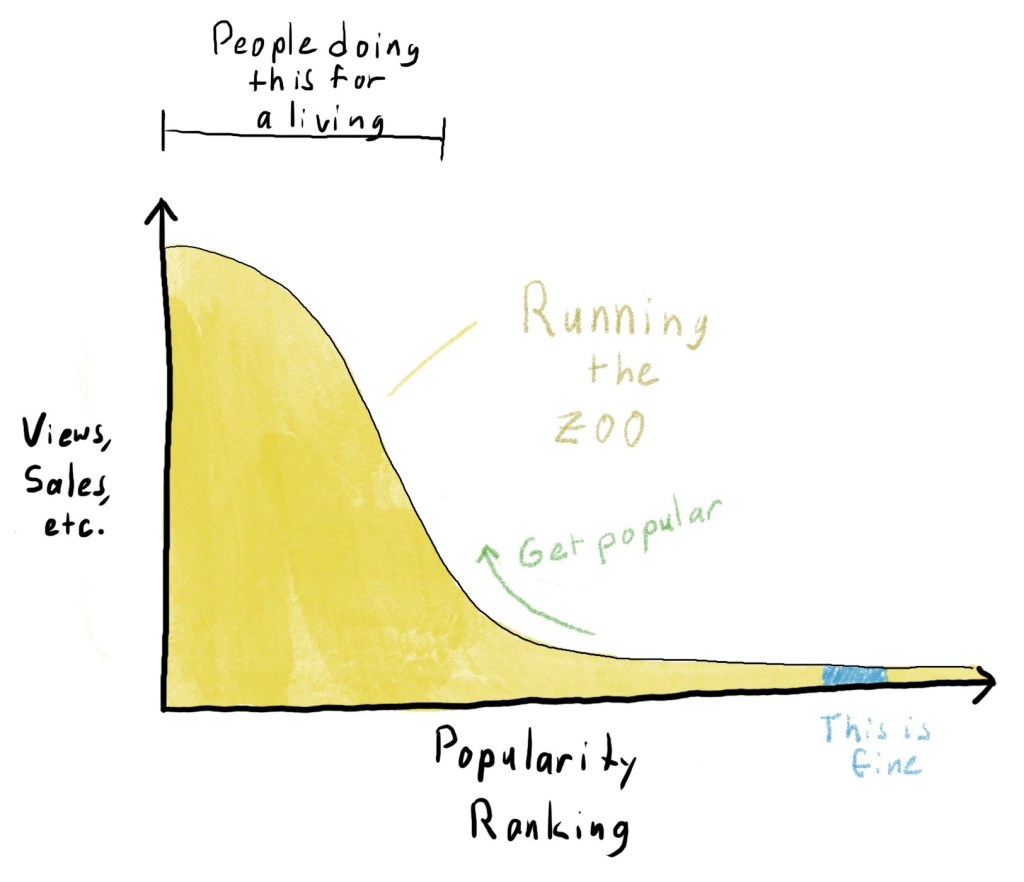
In the long-tail business model he describes, there are three categories of successful parties: people who migrate leftward from the long tail to the height of popularity, people who are fine staying in the long tail and not making much money, and the company operating the business as a whole.

Migrating leftward is hard. It takes time, dedication, broad appeal, and a lot of luck. You’re taking on the task of becoming Mr. Beast or Markiplier*. Being a money maker in a long-tail business means being popular or betting that something you make will become a viral sensation. In a sensational world, it’s getting harder and harder to be a sensation. And is that even what you want to do? Going viral doesn’t just mean making something that people love, it means making something that people are rabid about for a short period of time. Harnessing that success means keeping the hits coming.

Then there are people who are happy to get a few hundred views on YouTube or sell fifty-ish books to friends and friends-of-friends. That’s a fine and noble goal. But these people aren’t trying to run a business.

A graph comparing number of views or sales by ranking in popularity. Sales are high for the most popular few, but drop off quickly.
Ranking Versus Views

Shrimp Cult Press isn’t running a long-tail business model like Amazon. I do want it to be a successful business, but I also have no interest in turning my company into a hits machine with influencer-like appeal.

Printing on-demand would mean struggling to migrate leftward, pushing and fighting through the crowd to reach the front of the line. Yes, there’s an immediate cost savings to printing on-demand, but the low margins mean that you have to go even farther to escape the long-tail. If you’re only making a few bucks per book, the number you have to sell to be profitable is in the thousands. per month. Our most recent book, Pizza Pigeon: The Search for the Lost Parm, has almost paid for its printing in the first month since it’s been out. And everything from here is clear profit. You don’t get that from on-demand printing.

With the low margins of on-demand printing, you also can’t afford distribution outside of whatever printer you’re working with. Distributors take 30 to 40 percent off the cover price of your book. If you print on-demand, you’re locked into the printer’s audience. No small bookstores for you.

Printing the old fashion way has its downsides, but it’s easier to make more money once your audience reaches a certain (much smaller) size. It’s easier to be proud of the things you’re making, too.

It’s also worth noting that there are multiple ways to do just about anything. And it’s a wise to be suspicious of anyone who tells you that their way is the only way to be successful.

* I feel like I’ve just aged myself by referring to YouTubers, and that’s wild to me.

Categories
General

Between the Terms: Spring Break Artwork

I’ll admit: between the first two terms of the 2D Animation and Digital Art program at the Centre for Arts and Technology, the global pandemic, and just the rigours of being in a city that still doesn’t quite feel like home, I went into our spring break very much burnt out. It has become clear to me over the years that one of the tricks for dealing with burn-out is making the most of the free time you have, and for me, that often means letting go of all schedule and letting the spirit move me as it will. If that means working on a project, great! If it means sitting on the couch and binging Critical Role while I eat take-out pho, also great. My break ended up being a mix of all those things, although I tried to keep the pencil moving whenever I could.

So here’s a round-up of projects I worked on during our week-and-a-half-long break. Some are finished, some are still in progress, and some are being put aside, fun had and lessons learned.

A quick, one page comic about a cult of gummy bears raising a giant gummy bear from hell. Born from an inside joke, this comic was fun to make. It was an exercise in getting something finished quickly, and this page – from conception and planning to final image – took less than ten hours. There are narrative problems that I recognize (e.g. the icing has no purpose, there is a third candy head in the middle of the pentagram that isn’t explained) and intend to fix at some point, but I needed to have it finished, so I settled for “good enough for now.”
In-progress of the gummy bears comic. Once I had thumbnailed the panels separately, I drew in my construction lines with non-photo blue pencil, and then drew final lines with regular 2B pencil. I largely followed a technique laid out in a YouTube video by animator and comic artist Tony Cliff, whose work I absolutely loved in the graphic novel “Bubble”. This image was cleaned up and coloured in Photoshop to produce the final result.
The result of an off-hand joke in the web series Critical Role, I felt compelled to illustrate the Fantasy Uggs of Sneaking. My goal here was to practice rendering the focal point of the image to a higher level of detail than the background, and to experiment with loose brush strokes to imply texture.
These occurred to me right after I finished the Fantasy Uggs of Sneaking. Another experiment in loosely rendered backgrounds. I wanted the flops to have the curved, misshapen look that leather flip flops get after several seasons of use, right when they’re at their coziest.
A friend of mine is starting a game and IP development studio, and needed a website in a hurry. This was a fun opportunity to dip a toe back in the software world, and keep my engineering skills polished. Even though the work I did previously was mostly back-end, many of the same principles apply to front-end development. Over a period of 24 hours, with my friends mocks, I was able to get the site up, running, and fully responsive and mobile friendly. I used SASS for the first time, and loved it. You can see the finished page (and find out more about the studio!) at Ottodork.com.
Categories
General

Second Term of Animation School: Finished!

It’s hard to believe, but my second of five terms at the Centre for Arts and Technology’s 2D Animation and Digital Art program is complete! This term, it felt like we really started applying the fundamentals of animation that we learned in quarter one. I felt a massive improvement in my ability to draw human characters from my imagination, which has always been difficult to do to my satisfaction. Our character design class really pushed those skills and cemented the practice we’ve been doing in life drawing. Finally, our Drawing for Animation class gave me a chance to take a crack at drawing animation layouts.

Toward the end of this term, I realized that I need to focus on improving the timing in my animation. The motion in the last two assignments bothered me – it felt too rigid and unnatural. After a conversation with a contact in the industry, I now understand that my drawings were spaced too evenly. So one of my focuses for next term will be on achieving snappy, natural movement.

Next term, I’m looking forward to beginning digital animation in Adobe Animate/Flash, and learning more about storyboarding. I’m also hoping to work on adding more rhythm, flow, and spontaneity to my drawing in our life drawing class, in which we’ll be focusing on animal drawing.

Action analysis from a clip of a baseball player hitting a home run.
Action analysis from various reference videos of curling. The settle could be a little slower, and it would help to see some background elements moving to really sell the idea of motion.
Walk with a heavy weight. Alright, so the bucket should move less. That said, I’m proud of the slow in to the top that makes it look like the character is throwing their weight into moving the bucket, and of the asymmetrical, perspective foot slip.
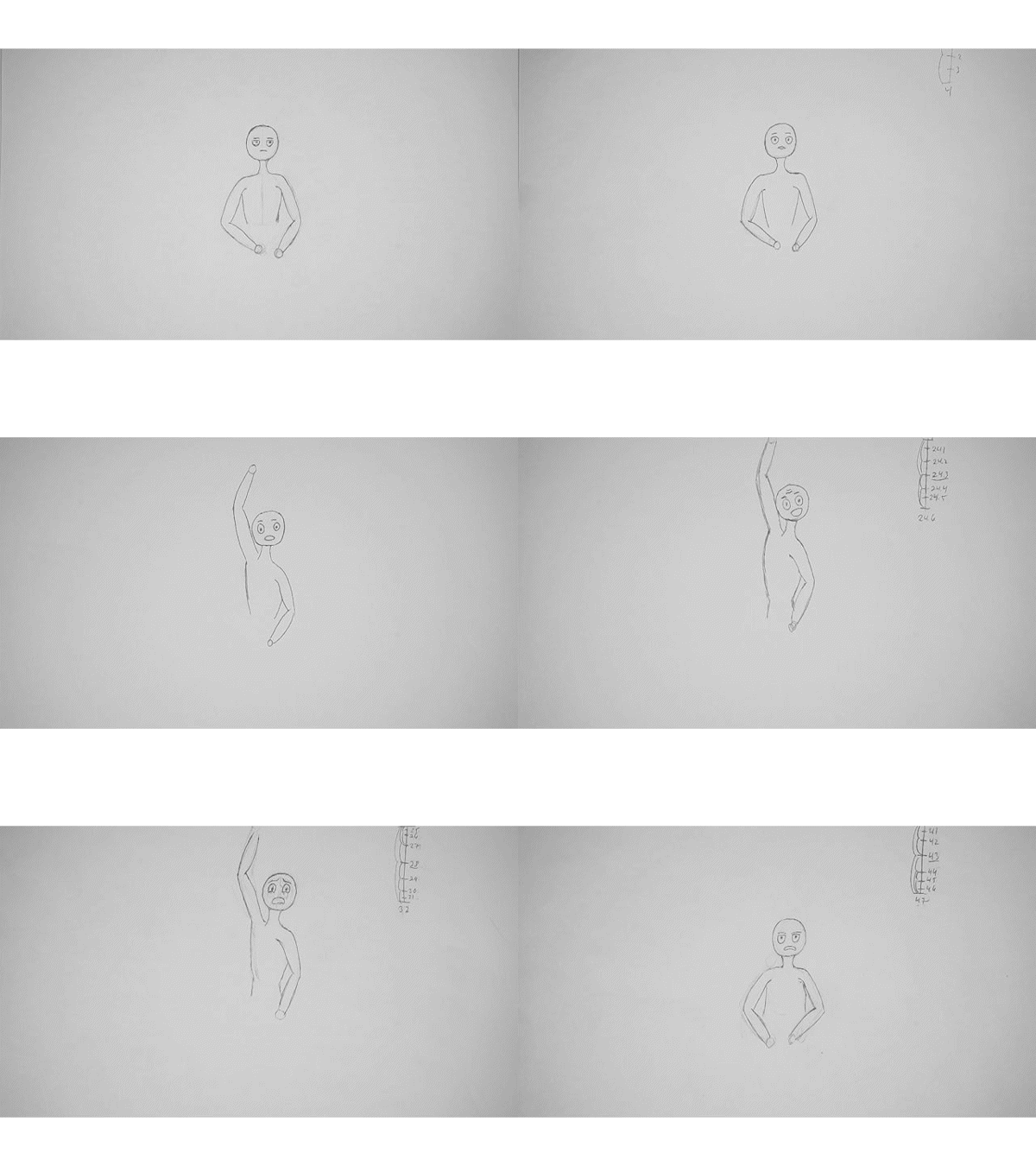
This, our second to last assignment of the term, illustrates the point I made earlier about unnatural timing. The clue (which I not see) is in the timing charts at the side: they’re all symmetrical! Not the best mime-acting assignment even done, but after all, school is a safe place to learn from your mistakes.
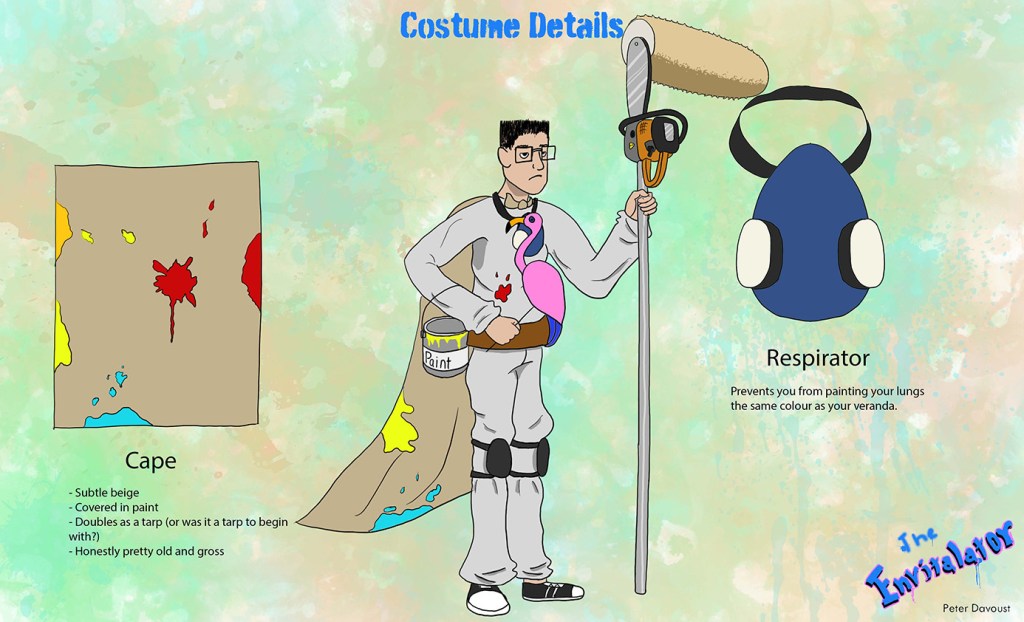
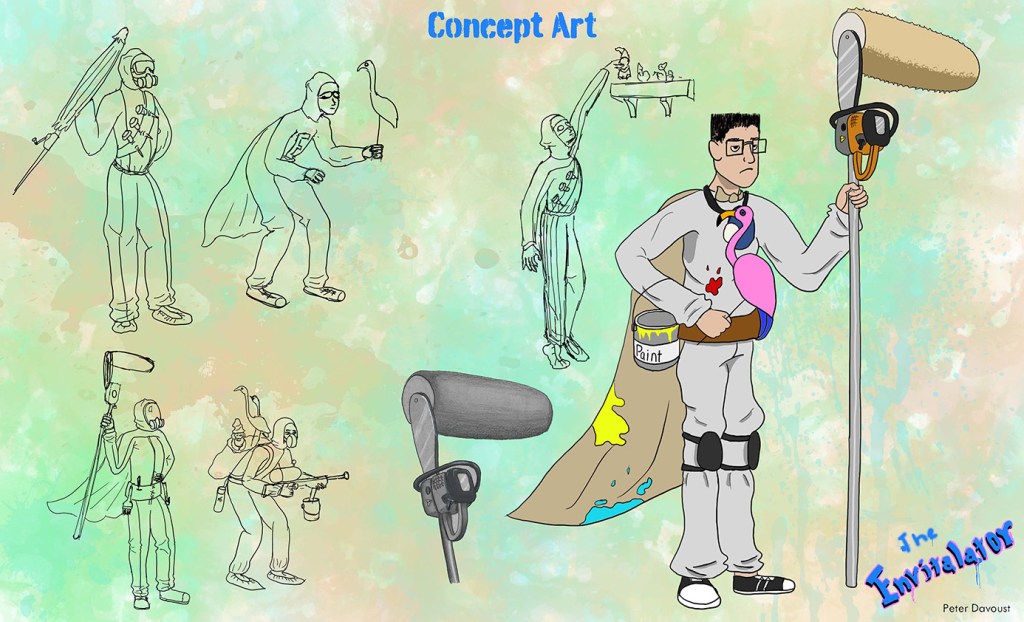
Final project for Character Design. Gary Sutherland (aka “The Envitalator” is a character I came up with for the class.)
I love the idea of the chainsaw paint roller or “power roller”. It looks mean, but it would in no way help you paint faster. In fact, it would mostly spray paint everywhere, except for a small, streaky patch on the wall, and that’s what I find so amusing about it.
Our first project for Character Design was for a character named Even, from a provided story about survivors of a near-future apocalypse. This was a landmark for me: the first character design I’ve done that I’m truly proud of.
A set design and value study for the same provided story as the Even character above. Drawn and rendered on 12-field animation paper with pencil.
Categories
General

First Term of Animation School Complete

My first term at the Centre for Arts and Technology just finished today! Even though there are four more quarters to go, I’m thrilled with what I’ve learned so far, excited for what I’ll learn in terms to come, and proud of myself for all the work I did during the term and to get here. It’s hard to believe that we’ve already finished 20% of the program!

Here are some of the highlights from the term.

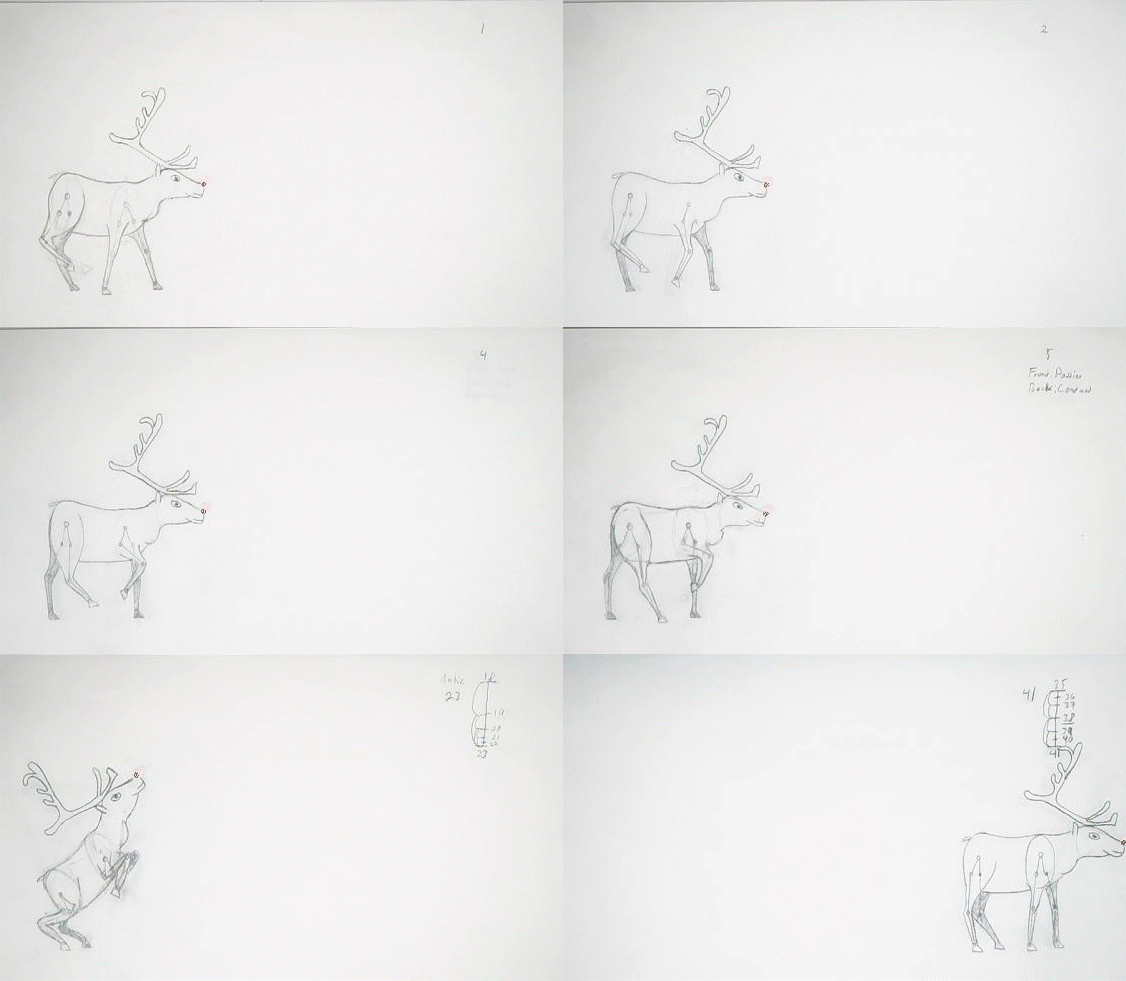
Rudolph running for almost four cycles, then jumping.
I tried something with the seams on the front of the sack that didn’t really work. Rather than making it look like the mass is rotating, they just look wrong. Unfortunately I realized this too late, but I’ve learned for next time.
First shot at effects animation.
Only the colour is my work. The original ink is by Zach Howard, and appears on the cover of Star Trek Alien Spotlight: Orions, issue 1A. Fun fact, I didn’t know what comic this was from when I began painting. My Star Trek senses are alive and well, apparently. (In Star Trek, Orions are aliens that look just like humans, except green.)
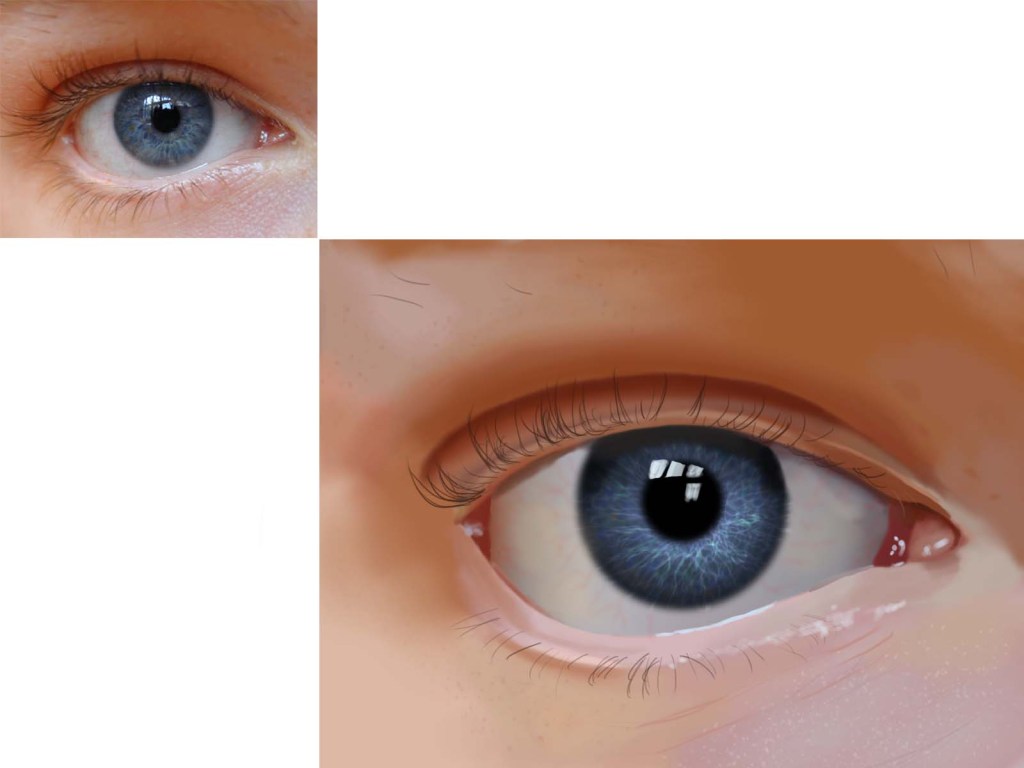
Our assignment was to do a painting of an eye. I’d like to continue working on getting the fine details in the skin texture right, but overall I’m pretty proud of how it turned out.

Next term, I’m looking forward to improving my life drawing skills, diving into acting in animation, and learning more about character design. We’re also taking a perspective class, and while I’ve already taken perspective, you can never practice it too much, and I’m excited to learn about organic perspective for the first time.

Categories
School

Presentation at CAT by Todd Ramsay

Today, Yeti Farm Creative owner and CCO Todd Ramsay came to speak to the first term students of the 2D Animation and Digital Art program at CAT. This was the first chance we’ve gotten to hear from a representative of an animation studio, and it was illuminating in a lot of ways. Todd took us through his history as an artist and how Yeti Farm was founded, and showed us several projects that he and his company have worked on.

It was reassuring to hear that, like me, Todd didn’t go straight into animation right out of school. He gave us some tips for success, and told us about a few things that had and hadn’t worked in his career. I especially appreciated that he took the time to answer all of our questions about the industry and about Yeti Farm candidly and directly.

Sometimes in school, a future career can feel a bit abstract and far away, and listening to Todd’s presentation made working as an animator feel a bit more real and tangible, bringing up (and answering) questions I didn’t know I had, relieving concerns, and giving me things to focus on as I continue to learn. I’m glad we had this presentation so early on in our program, and I appreciate Todd taking the time to speak to us.

Categories
General

Hello!

My name is Peter Davoust. I’m an animation and illustration student at the Centre for Arts and Technology. I like visual storytelling, cartoon animals, and art that makes the world a better place. When I graduate from CAT, I hope to make all three.